

Christians who live their lives knowing about the saints and feeling their support possess a treasure. Through the good example the saints left behind, they show us how to live good and virtuous lives. When we pray to them, we are really praying to God and asking the saints to strengthen our prayers by praying with us. Finally, they guide and protect us.
When the saint with whom we feel a friendship is St. Joseph, we have found the kind of heavenly friend who can make the most impossible situations manageable.
Joseph’s Vocation
Consider St. Joseph’s position when he lived with Mary and Jesus. Even before the numerous New Testament instructions we now have, as faithful Jews their lives would have been guided by the biblical words from the book of Genesis (18:19): “For I know … that he will command his children and his household after him.” Accordingly, they lived in a culture in which the man of the house was acknowledged as the head of the household, bearing serious responsibility for the well-being of the family he was to lead. Called by God not only to provide care and safety but to lead his family as well, Joseph’s family was the Holy Family, consisting of the Son of God and the Mother of God!
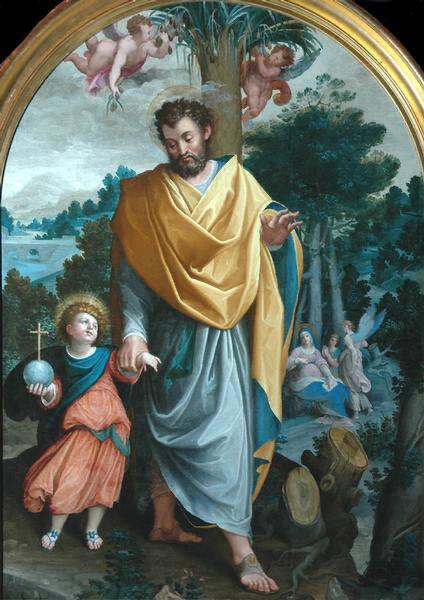
Joseph’s challenges are compounded when we realize that he was often called upon to react to some aspect of the mystery of his foster Son’s Incarnation without having been given an explanation ahead of time. Our Lady herself— to whom the angel Gabriel spoke on behalf of God to seek her permission to receive the Christ Child in her womb—had the benefit of Gabriel’s explanation at the Annunciation. Joseph’s clarification came later in a dream, after he had already struggled with the consequences of the Incarnation.
Joseph’s Trials
At other times Joseph needed to lead his family calmly to safety amid situations that introduced panic rather than calmness into their lives. They lived in a slave economy in which kidnapping was common. A family traveling alone in the desert at night would have been a vulnerable target. Thus, Joseph’s flight to protect the Child from those pursuing His life carried dangers beyond the political threat alone.
Consider also the pressure Joseph would have felt when the Child was lost at twelve years of age. In a world where kidnapping was common, the danger would have been real. Where did Joseph’s fears travel during those three days? Did he ask himself again and again, “Where was that boy?” “What has become of Him?” “How can I protect that boy if he has gotten into trouble beyond my means to solve? Where is Jesus?” And what restraint Joseph must have exercised on the journey home that evening. With a sinless Son and a sinless wife, it is safe to assume that when the three days’ absence was discussed, Joseph in an understated manner simply “gave an opinion” about such matters.
Did Joseph also figure into the narrative of Matthew 12:48–50? If anyone understood the seriousness of Our Lord’s mission, it was Mary. Why, then, would she attempt to interrupt Him while He was teaching? Perhaps her message was urgent: “Your father is on his deathbed. Joseph is dying. Please come home.” And how might Our Lord’s response have sounded to Joseph’s ears when the episode was later explained? Joseph received this and every other challenging message he encountered as the foster father of Our Lord in the same docile spirit that enabled a strong and virtuous man to find his vocation as the least important person in the family he was called to serve as its head.
Joseph’s Lesson for Us
St. Joseph teaches us—again and again—that when we face seemingly impossible tasks, monumental challenges to our virtue, or offenses to our sense of justice, the virtuous person grows in holiness by swallowing pride and acknowledging the greatness of God:
“Father, this is hard teaching for me. This is almost an impossible challenge, but I will not let it become impossible. I will turn to you and await your lead. I may even render an ‘opinion’ unworthy of me, but through the example of the just man, Saint Joseph, and the members of his family, I will cling to you and resolve to live the words: ‘Thy will be done.’”
Fr. Michael Monshau, OP