Our Lady of Guadalupe is perhaps the most significant and well-known Marian devotion in Hispanic communities of the United States, and indeed the Western Hemisphere. The story and the image are familiar. An ordinary man, Juan Diego, encounters the Blessed Mother on the road to his destination. She asks him to be her special messenger and champion; while he is occupied with his unworthiness, he eventually assents and is the occasion of a miraculous sign presented to the bishop, who then begins to promote Our Lady of Guadalupe.
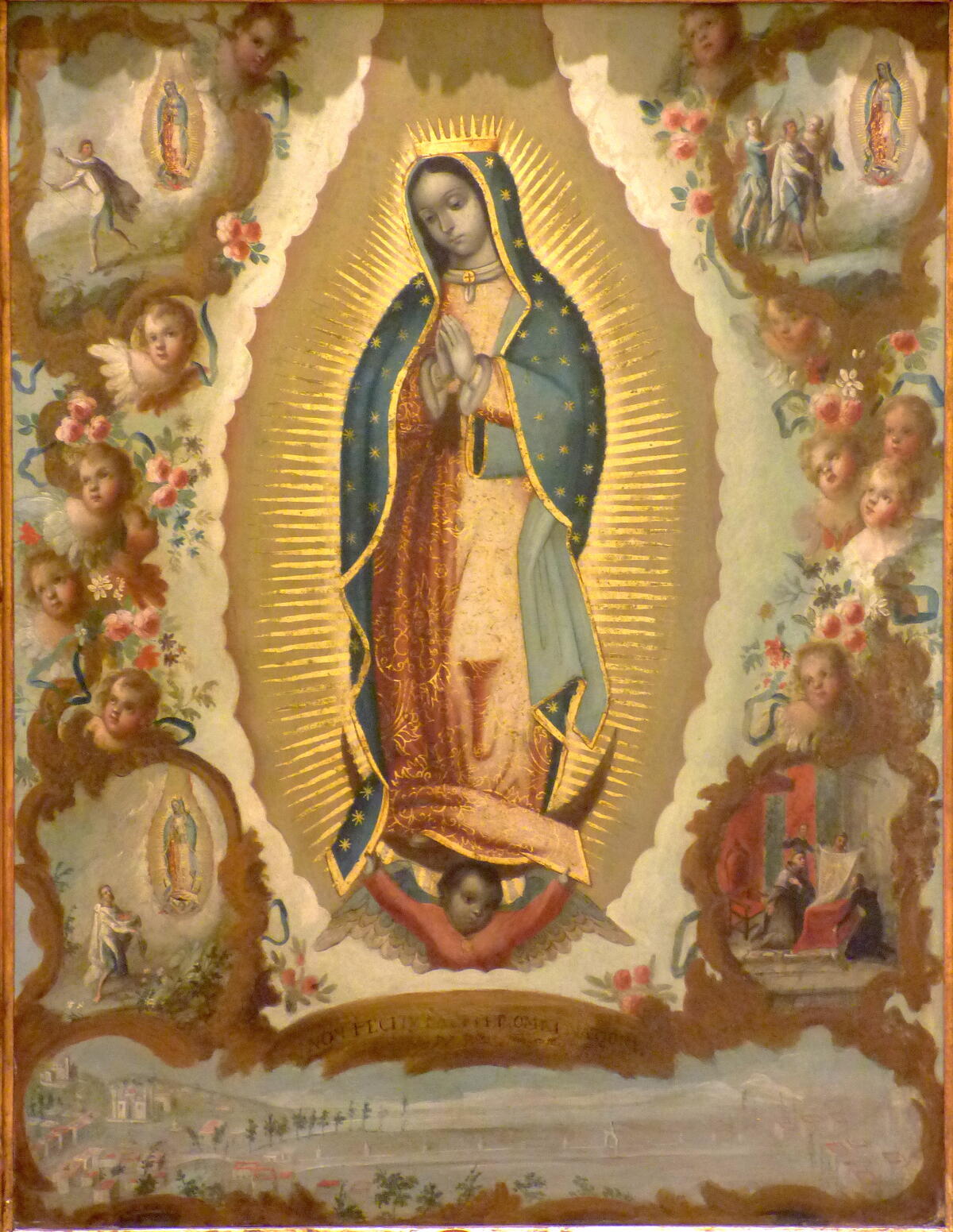
That account, while true, does not tell us about how that image and devotion are different from the numerous other appearances around that time and place, all of which were specific to particular locales. The story of Our Lady of Guadalupe becoming a national figure is part of the story as well; to boot it is a Dominican story.
Bishop Juan de Zumarraga, before whom Juan Diego appeared, was a Franciscan friar before he became a bishop. Though he was initially suspicious of Juan Diego’s account, he was convinced by the sign and promoted the devotion locally. His promotion of the apparition helped to bring about a massive first wave of conversions – some estimate millions in the years immediately following. There was opposition in some places; because many symbols associated with Our Lady of Guadalupe evoked symbols of the native religion, there was hesitancy and suspicion within Bishop Zumarraga’s Franciscan community. It seems that, regardless of Bishop Zumarraga’s motivations, the Franciscans were willing to promote Our Lady of Guadalupe as a means of containing what they saw as tendencies to minimize the distinctiveness of Christian religion.
Zumarraga’s Dominican successor, Alonso de Montufar, had a proactive outlook, which expanded on Zumarraga’s work; he saw Guadalupe’s rich symbolism an opportunity to make her a driving force for Catholicism in all of what was then New Spain, using her rich message and imagery to inculturate the faith more fully among the native population. This was controversial; in the wake of this more universal and full-throated affirmation of Guadalupe, the Franciscan regional superior – Francisco de Bustamante – condemned Our Lady of Guadalupe as syncretistic, and a reduction of Catholicism to native sentiment. In time, Montufar’s instinct proved to be the more durable. The virgin of Guadalupe was indeed a major catalyst for the continued conversion of the Old World, and came to be associated with an old Spanish devotion by a related name (Our Lady of Guadalupe of Extremadura), and so served as a source of succor to faithful in the Old World as well as the New.
There are lessons to be taken from this. It is certainly the case that, in Juan Diego’s time and in the time of Zumarraga and Montufar, there were people who embraced Our Lady of Guadalupe in a less than fully Christian way, vindicating the concerns of Bustamante and those who held his opinion. In spite of this, it is clear that Our Lady was able to redeem what was good in that devotion, help the Catholic faith to fully embrace the native culture and consecrate it to her Son. In an extended way, it testifies to an aspect of our Dominican charism; discerning potential channels for grace, creating the space for them to flow freely, and acting as stewards of that grace to continue to cultivate and draw out its effects.
On this Feast of Our Lady of Guadalupe, let us give thanks for Our Lady's patronage of the New World, give thanks for Juan Diego to whom she appeared, and give thanks to those discerning men in the church: Bishop Zumarraga, Bishop Montufar and the many others who have helped Our Lady be known to this day.
Our Lady of Guadalupe, pray for us!
Fr. James Pierce Cavanaugh, OP
Promoter of the Holy Rosary